
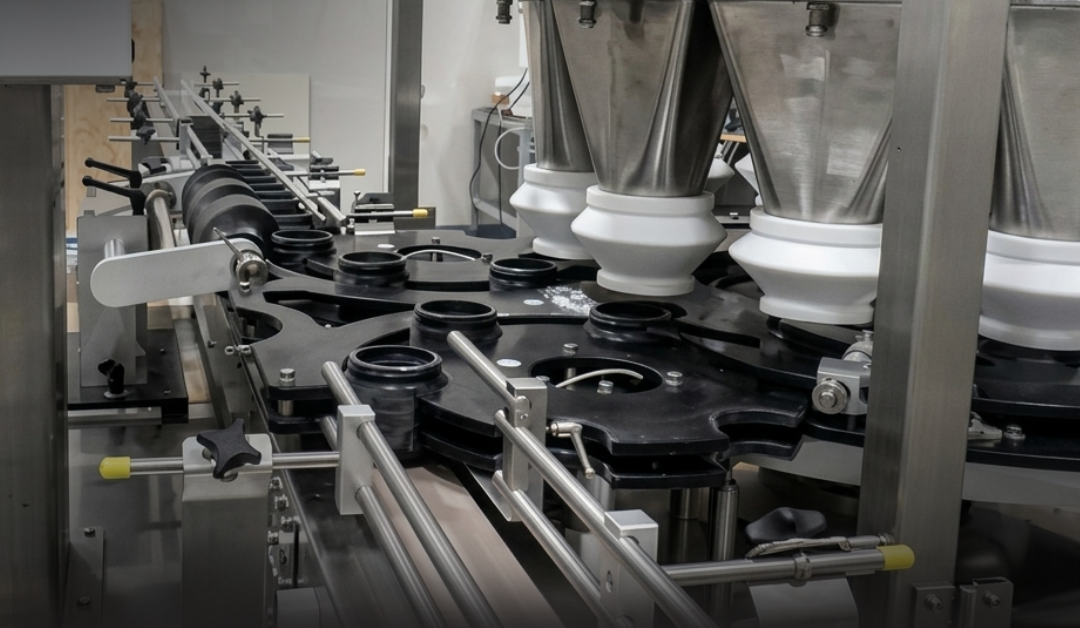
In modern packaging operations, the filling process is only as reliable as the container handling system that feeds it.
While filling technologies often get the spotlight, experienced engineers know the real challenge frequently lies upstream—getting containers into the fill station accurately, consistently, and at speed.
At high throughput rates, even small variations in container geometry, material, or stability can cause major disruptions. Containers can tip, misalign, jam, or fail to properly engage with the filling nozzle—reducing efficiency, increasing downtime, and creating costly product waste.
At AMS Filling Systems, container handling is not treated as a standard conveyor problem—it’s an engineering discipline.
Over years of designing custom filling solutions, AMS has developed specialized container control methods to solve some of the most difficult packaging scenarios.
Handling Small, Unstable Containers at High Throughput
Small containers present unique challenges in automated filling environments. Their limited footprint makes them inherently unstable—especially at high speeds.
Even minor vibration or upstream pressure can lead to tipping or misalignment before the fill station.
AMS Solution:
- Custom stainless steel change parts designed for the exact container footprint
- Container clamps with integrated centering devices
- Diving nozzles that enter the container opening to reduce splashing and improve accuracy
By combining mechanical stabilization with precise nozzle engagement, AMS enables small containers to run reliably at high production speeds.
Stabilizing Tall and Narrow Containers
Tall, narrow containers introduce a different issue: a high center of gravity. These containers are prone to tipping or leaning during indexing—particularly in high-speed operations.
AMS Solution:
- Indexing blades (instead of standard pins) for greater surface engagement
- Custom tall guiderails for continuous support
- Precision indexing control to reduce abrupt motion
These enhancements ensure that even slender containers remain stable throughout the filling process.
Preventing Shingling in High-Speed Lines
Shingling is one of the most common—and often overlooked—container handling problems.
It occurs when containers overlap or crowd together due to line pressure and geometry, leading to misalignment before the filling station.
Without proper control, shingling can cause:
- Container jams
- Misfeeds into the filling station
- Reduced line efficiency
AMS Solution:
- Overhead guide rails to control container crowding
- Specialized indexing systems (such as pressure pads) for consistent separation
- Line pressure management to maintain spacing
By actively controlling container flow, AMS prevents shingling before it disrupts production.
Managing Pails and Bail Handles in Automated Filling
Pails introduce a unique complication: bail handles.
As pails move through a filling system, these handles can catch on guiderails or mechanical components—causing significant disruptions, especially at high speeds.
AMS Solution:
- Custom pail bail rails to guide handles away from interference points
- Reinforced welded structures to maintain handle control throughout the process
These modifications allow pails to move smoothly through the system without entanglement or stoppages.
Expertise Across Container Materials
Container handling challenges are not just about shape—they’re also about material behavior.
Different materials respond differently under automation:
- Plastic can flex under pressure
- Glass requires careful handling to prevent breakage
- Metal often demands specialized engagement methods
- Composites introduce mixed mechanical characteristics
AMS has extensive experience engineering solutions across all these materials, ensuring optimal performance regardless of container type.
Why Container Handling Expertise Matters
In automated filling operations, container handling is often the hidden factor that determines whether a line runs smoothly—or constantly struggles.
Companies that overlook this critical element often face:
- Frequent line stoppages
- Container jams and misfeeds
- Reduced throughput
- Increased maintenance and operator intervention
AMS takes a different approach.
By treating container control, stabilization, and indexing as core design elements—not afterthoughts—AMS ensures containers arrive at the fill station exactly as they should, every time.
Final Thought
When container handling is engineered correctly, everything downstream improves—efficiency increases, waste decreases, and production becomes predictable.
That’s the AMS difference.